AI Doesn't Need More Data. It Needs Better Context.

AI Doesn’t Need More Data. It Needs Better Context.
The next wave of automation is about meaning, not models.
AI isn’t intelligent. It’s interpretive. And interpretation depends on context, not just data.
That’s the truth behind millions in AI investments that still can’t answer simple business questions. The problem isn’t your data. Your data has no idea what it means.
The Real Problem No One Names
Everyone says “bad data breaks AI.” The harder question: why is the data bad?
Data fails not from incompleteness but disconnection. A customer name in a spreadsheet, a quote in an email, and a policy in a PDF describe the same story in different silos, different languages, parallel universes. Without context, AI can’t connect them. Automation breaks, and hallucinations follow.
Recent research confirms what practitioners have suspected all along. Serra et al. (2022) demonstrated that data quality is inherently tied to fitness for use, and that fitness for use is fundamentally contextual. As they put it, “No single set of quality metrics can fit all applications. Task-dependent and context-aware assessment is necessary.” In other words, there’s no such thing as universally “good” data. There’s only data that makes sense in a specific context.
Fu et al. (2024) went further, showing that completeness and interpretability aren’t fixed properties. They’re domain-specific and context-dependent. The same dataset that’s perfectly complete for one use case is woefully inadequate for another. The difference? Context.
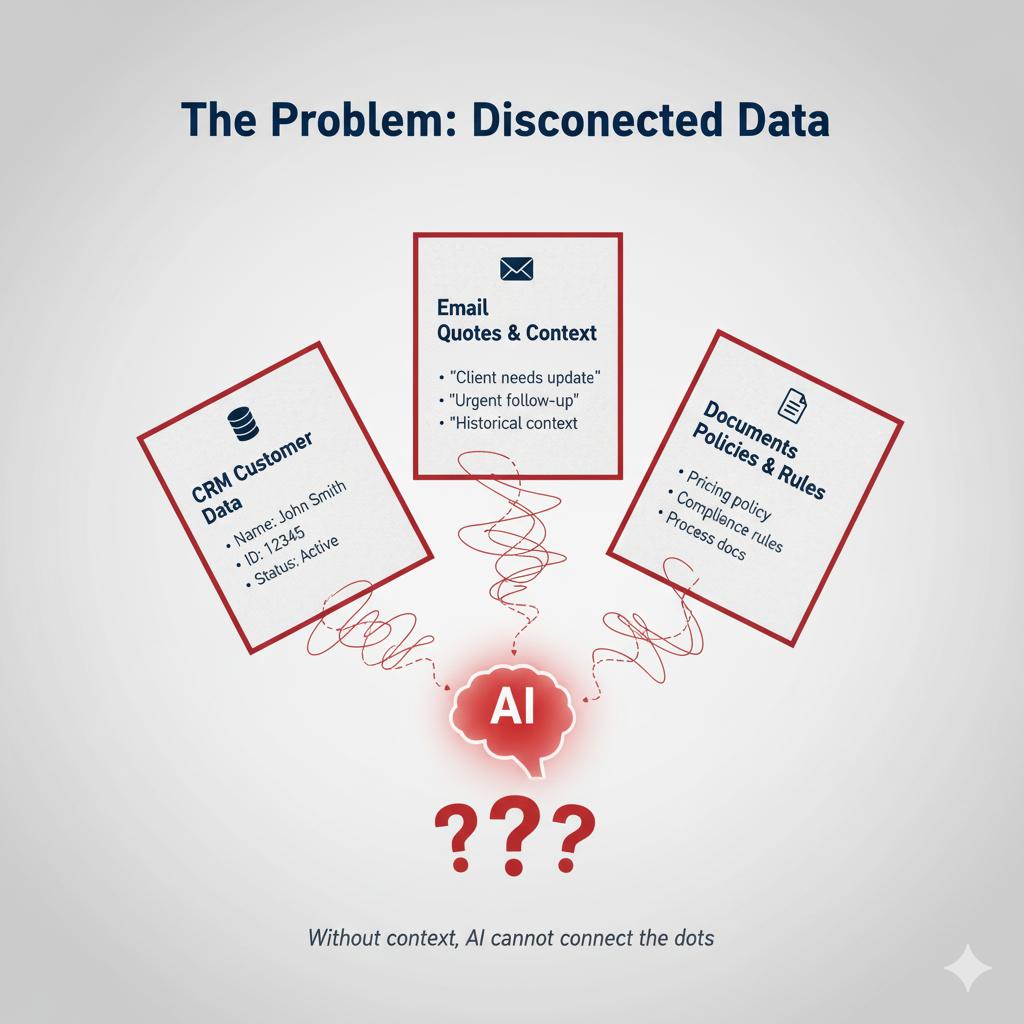
From Storage to Understanding
The last decade solved storage and compute. We can store petabytes and process them instantly. Yet most companies can’t answer basic questions about their own operations.
Having data and understanding data are different problems. The next wave goes to whoever builds infrastructure that turns disconnected information into connected meaning.
Putrama et al. (2024) surveyed the landscape of heterogeneous data integration and identified a critical gap: “semantic alignment and context inference remain open problems.” We’ve mastered moving data between systems. We haven’t mastered making that data mean something consistent across systems.
The challenge is clear: AI can find patterns and match datasets technically, but it can’t understand your business. That understanding has to be built in.
The Intelligence Your Business Already Has
Most organizations already have intelligence, scattered across inboxes, documents, spreadsheets, and chat threads. Corporate memory lives in the email explaining why that database field shifted in Q3. In meeting notes clarifying what “customer type C” means. In institutional knowledge that walks out the door when people leave.
Khan and Vorley (2017) documented that unstructured data (text, emails, documents) holds vast amounts of tacit organizational knowledge that traditional systems miss. This context makes everything else intelligible.
The real challenge isn’t extraction. It’s connection. Turning fragments of meaning scattered across dozens of systems into coherent understanding that AI can use.
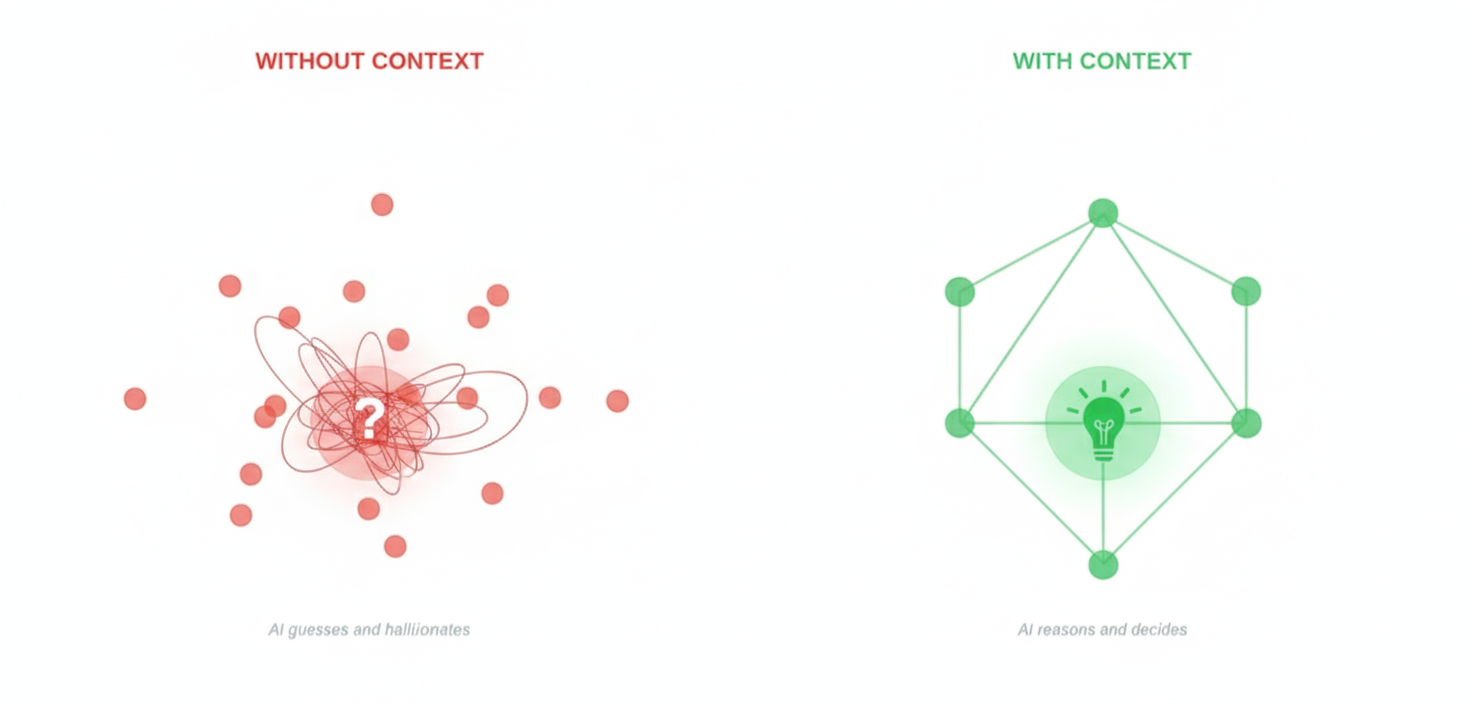
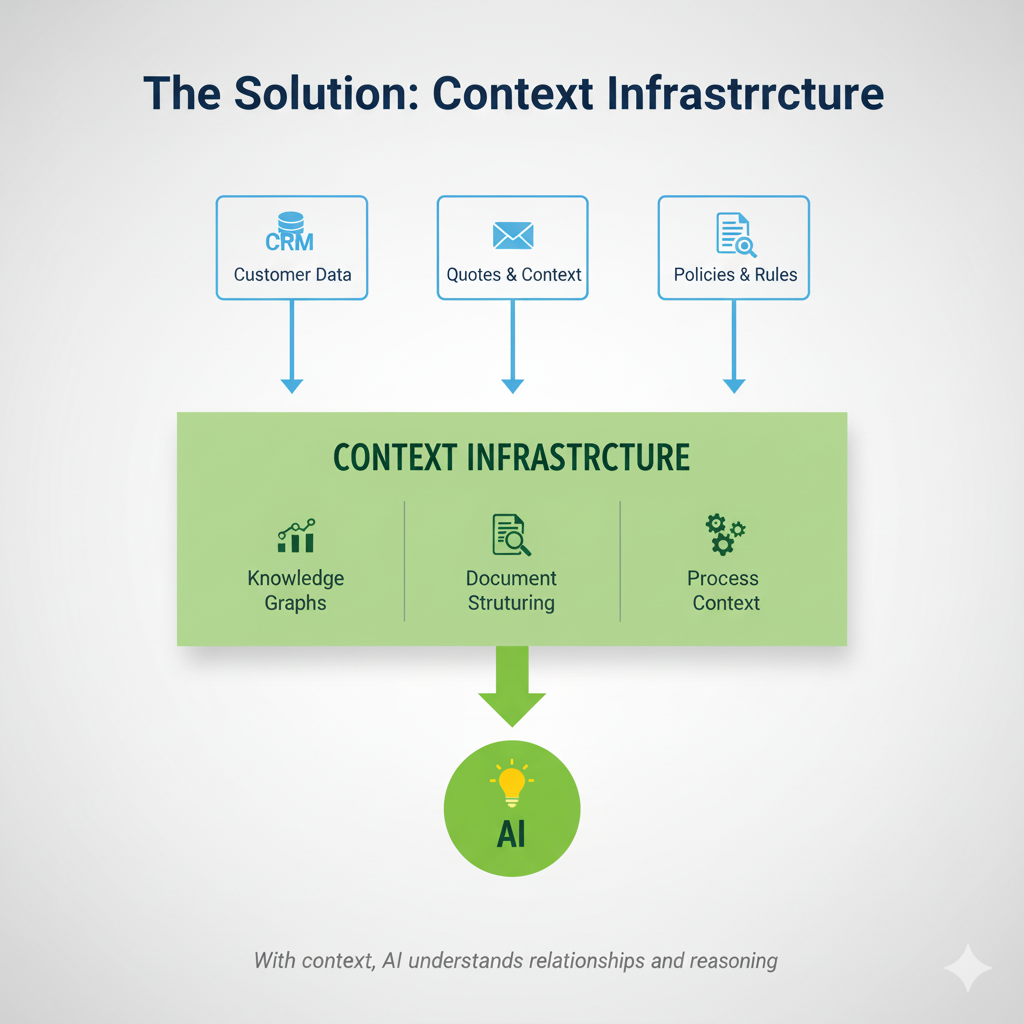
Context Infrastructure: The Missing Layer
Context infrastructure makes unstructured data structured, connected, and actionable. Three components:
Turning language into relationships. Knowledge graphs connect disparate information semantically. Peng et al. (2023) showed knowledge graphs enable integration across systems in ways traditional databases can’t. When your graph recognizes that a customer in CRM, billing, and support systems is the same entity, you’re not linking records. You’re building understanding.
Extracting structure from documents and workflows. Business intelligence lives in Word documents, PDFs, emails, Slack threads, rarely in structured databases. Context infrastructure surfaces this and maps it into your semantic framework.
Capturing process context, not just content. Know why data matters, when it’s relevant, how it drives decisions. That’s the difference between having purchase history and understanding buying patterns in context of seasonality, launches, and competition.
Schramm et al. (2024) found that giving AI structured context improves interpretability and reasoning. Combined LLMs and structured knowledge reduce hallucination dramatically.
When AI operates on connected meaning instead of disconnected points, it stops guessing and starts reasoning.
The Business Case for Context
Context infrastructure delivers three capabilities:
Visibility. Make institutional knowledge discoverable. When someone asks “what’s our policy on X,” the answer should be available and connected across the organization, not “ask Sarah.”
Connection. Link fragments into coherent stories. A support complaint automatically connects to purchase history, account status, interactions, and documentation. That’s minimum viable context for good decisions.
Action. Drive automation grounded in understanding. Systems that know why something happened and what it means make intelligent decisions, not rigid rules.
This is the layer between data management and AI, letting your business use its own intelligence safely, accurately, and fast.
The Path Forward
Companies that master context own the next decade of AI. They stop chasing data quantity and design data meaning. They build systems that understand relationships, not records.
The AI revolution goes to whoever builds context infrastructure, making data intelligible to humans and machines.
Shift your question from “How do we feed more data to the model?” to “How do we make our data understand itself?”
Winners automate faster, decide better, scale efficiently. Not from more information, but from connected information.
We’re not building artificial intelligence. We’re revealing the intelligence your business already has.
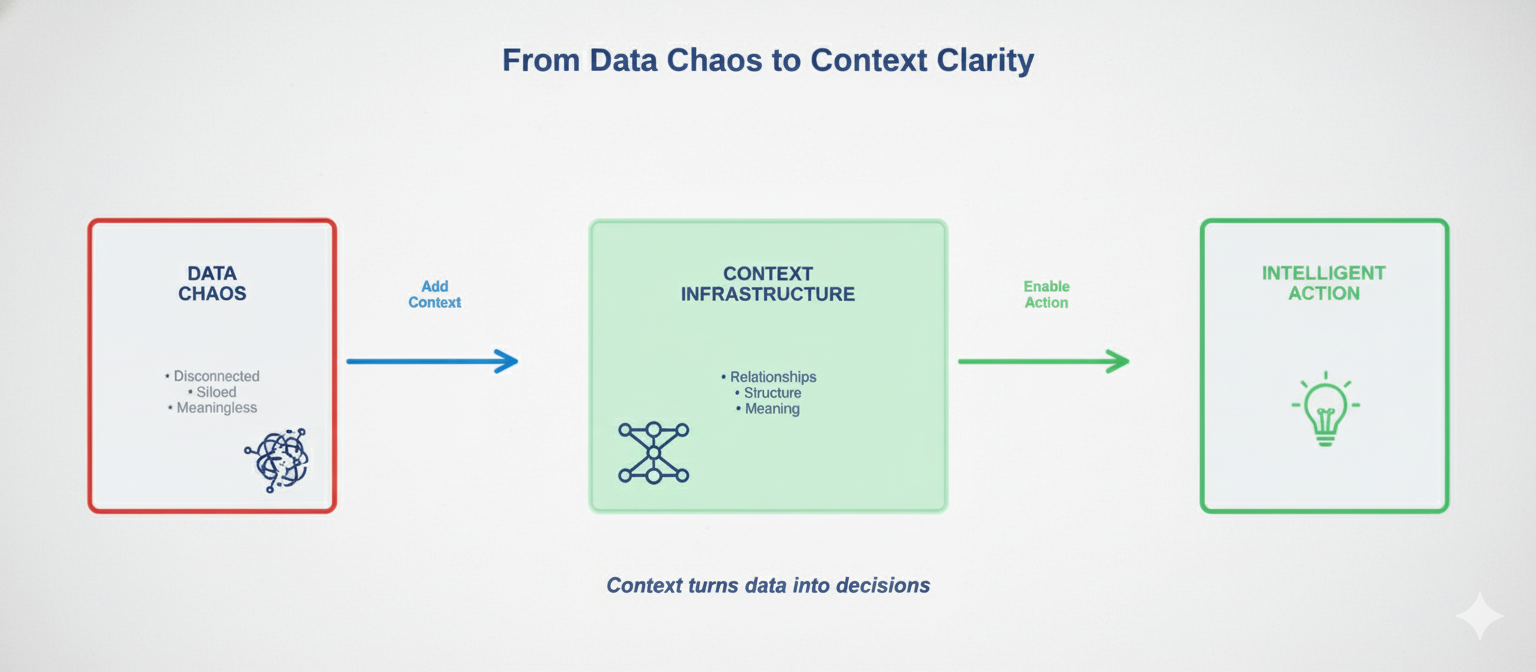
“Data tells you what happened. Context tells you why. That’s where intelligence begins.”
References
Fu, X. et al. (2024). “Understanding Data Quality in a Data-Driven Industry Context.” Journal of Industrial Information Integration, Elsevier.
Khan, Z. & Vorley, T. (2017). “Big Data Text Analytics as an Enabler of Knowledge Management.” Journal of Knowledge Management.
Peng, Y. et al. (2023). “Knowledge Graphs: Opportunities and Challenges.” Artificial Intelligence Review, Springer.
Putrama, I.M. et al. (2024). “Heterogeneous Data Integration: Challenges and Opportunities.” Data in Brief, Elsevier.
Schramm, A. et al. (2024). “Comprehensible Artificial Intelligence on Knowledge Graphs: A Survey.” arXiv:2404.03499.
Serra, F. et al. (2022). “Use of Context in Data Quality Management: a Systematic Literature Review.” arXiv:2204.10655.